
By Torsten Schmidt, Managing Director and CEO, Daimler India Commercial Vehicles
As Daimler Truck marks 130 years since the invention of the world’s first truck, the lessons of mobility remain central to India’s next phase of economic growth. Every economy creates opportunity. The most successful ones are the ones that can move it.
A farmer may produce more than a local market can consume. A manufacturer may build world-class products. An entrepreneur may identify demand hundreds of kilometres away. Yet none of those opportunities creates economic value unless products, services and ideas can reach the people who need them.
India’s Growth Story Is Also a Mobility Story
India’s growth story is often told through defining milestones- the expansion of railways, the rise of manufacturing, the Green Revolution, economic liberalisation and, more recently, the digital economy. Yet behind each of these chapters lies a quieter force that rarely receives the attention it deserves- the ability to move goods efficiently.
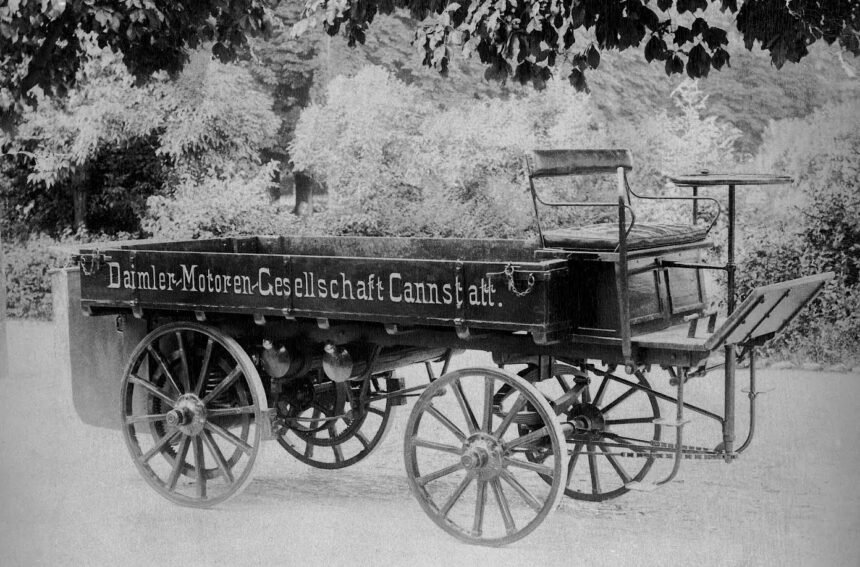
For over 130 years, Daimler Truck has helped shape the relationship between mobility and economic progress. When Gottlieb Daimler’s team introduced the world’s first truck in 1896, it was more than a new vehicle. It was a new way for economies to connect production with demand, businesses with customers and opportunity with growth. Across generations, industrial revolutions and evolving supply chains, one principle has remained consistent- when mobility improves, opportunity expands. Today, that same story continues in one of the world’s fastest-growing economies, India.
Before the Truck: When Distance Limited Opportunity
For much of history, India’s economic potential was constrained by geography. Farmers relied on bullock carts to transport produce to nearby mandis. Traders moved goods through fragmented networks of roads, waterways and railways. While rail transportation expanded connectivity across regions, the first and last mile remained slow, uncertain and often disconnected.
As a result, businesses frequently organised themselves around transportation limitations rather than market opportunities. Commercial vehicles changed that equation. They expanded economic reach, enabling businesses to connect directly with customers, manufacturers to access larger markets and infrastructure projects to receive materials where and when they were needed. What appeared to be a transportation breakthrough was, in reality, an economic one.
India’s Freight Revolution
India’s economic transformation over the past few decades has been accompanied by an equally important transformation in mobility. As manufacturing expanded, national highways improved, industrial corridors emerged and supply chains became more integrated, the movement of goods became faster, more reliable and more efficient. Businesses that once operated within regional boundaries increasingly gained access to national markets. Agricultural produce could travel further while retaining value, while manufacturers could scale production with greater confidence, knowing that products could reach customers across the country.
Having worked across markets including Brazil, Japan and India, I have seen firsthand how mobility reflects the stage of an economy’s development. As infrastructure improves and supply chains become more connected, businesses gain confidence to invest, expand and serve new markets. What makes India particularly compelling is the scale and speed at which this transformation is unfolding. In a relatively short period, the country has strengthened its logistics networks, expanded manufacturing capacity and connected producers with customers in ways that were difficult to imagine a generation ago.
India’s Next Competitive Advantage
India is entering a new growth phase. Manufacturing is expanding. Infrastructure investment continues to accelerate. Supply chains are becoming more connected, and customer expectations are increasingly defined by speed, visibility and reliability.
The challenge facing India is no longer whether it can create opportunity. It is whether it can move opportunities faster, smarter and more sustainably than before.
Road transport already carries a substantial share of domestic freight, making mobility one of the country’s most important economic enablers. As supply chains become more sophisticated and markets more interconnected, competitive advantage will increasingly be determined by how effectively businesses can connect production, distribution and demand. Initiatives such as PM Gati Shakti, the growth of multimodal logistics networks and the emergence of digital freight platforms are helping create a more integrated logistics ecosystem. Combined with connected vehicles, real-time data, predictive maintenance and increasingly sustainable technologies, these developments will enable businesses to move goods more efficiently while improving visibility across the supply chain.
Opportunity in Motion
For Daimler Truck, 130 years is more than a milestone. It is the continuation of a belief that began with the world’s first truck and has remained relevant across generations, industries and economies. As manufacturing expands, infrastructure investment accelerates and supply chains become increasingly interconnected, mobility will play a defining role in determining how quickly opportunity can translate into prosperity. As India enters its next phase of growth, the lesson of the past 130 years remains as relevant as ever- economic progress depends not only on the opportunities an economy creates, but on how effectively it can move them.