Staff Writer
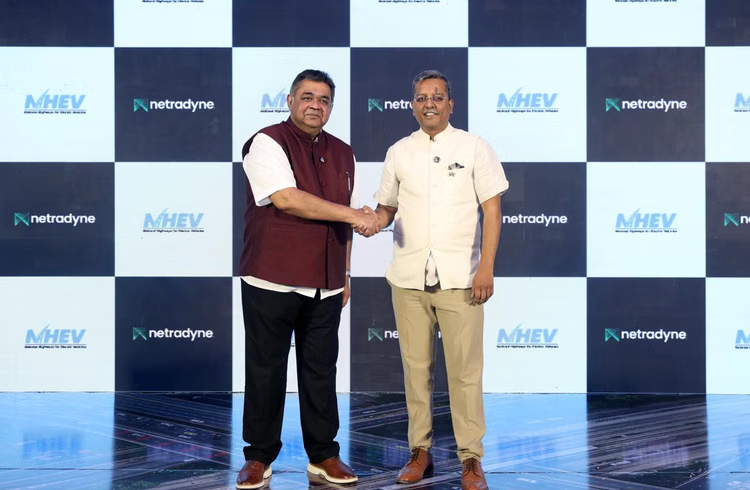
New Delhi: AI-powered fleet safety and mobility technology company Netradyne has partnered with National Highways for Electric Vehicles (NHEV) to deploy intelligent safety and operational monitoring systems across India’s emerging electronic highway network, a move aimed at strengthening the country’s long-distance electric mobility ecosystem.
Under the collaboration, Netradyne will provide the intelligence and safety layer for commercial electric vehicles operating on NHEV-supported corridors, enabling real-time fleet visibility, predictive risk detection, driver behaviour analytics and operational monitoring across the network.
The deployment will be rolled out in phases and forms part of NHEV’s broader strategy to transform conventional highways into connected Electronic Highways capable of supporting large-scale electric mobility through integrated charging, digital infrastructure, energy management and operational support systems.
NHEV plans to expand its Electronic Highway network across 26 highway corridors by 2027 as part of its efforts to create a commercially viable ecosystem for long-distance electric transportation in India.
As part of the partnership, Netradyne’s artificial intelligence platform will provide driver behaviour insights, vehicle health monitoring and corridor-level operational oversight, helping fleet operators improve safety, vehicle utilisation and operational efficiency.
“The world has seen what broken supply chains and oil shocks can do to an economy. NHEV E-Highways are India’s preparedness-driven economic lifeline, ensuring that the movement of essential goods never stops, whether during peacetime, lockdowns, or geopolitical oil crises impacting global supply chains,” said Abhijeet Sinha, Program Director, NHEV.
Sinha said India’s Electronic Highway vision extends beyond charging infrastructure and aims to create a connected and trusted mobility ecosystem capable of accelerating commercial EV adoption.
“India’s E-Highway vision is not only about the charging infrastructure layer, but also about building a connected and trusted mobility ecosystem to gain the confidence of the commercial EV and freight transport sector. This electronic layer will play a critical role in improving driver safety, reducing accidents, enabling predictive risk detection and strengthening operational reliability for freight fleet operators and passengers alike,” he said.
He added that technology partners such as Netradyne are helping strengthen the intelligence layer necessary to make the network operationally dependable, bankable and commercially viable at scale.
Durgadutt Nedungadi, Senior Vice President, EMEA and APAC Business at Netradyne, said the collaboration reflects the growing role of artificial intelligence in the development of next-generation mobility infrastructure.
“Being part of NHEV’s Electronic Highway initiative reflects the scale at which AI-driven mobility infrastructure is evolving in India. Our role is to provide real-time intelligence that improves driver safety, fleet visibility and operational responsiveness across these E-Highways,” Nedungadi said.
“By enabling early detection of driver fatigue, unsafe behaviour and vehicle distress, we can help reduce road risk and make long-haul EV operations safer and more reliable,” he added.
According to the organisations, the initiative will also support policy development through real-world implementation and validation, contributing recommendations to the Group of Transport Experts (GTE) and aligning with broader government efforts to integrate transport, telecommunications and digital infrastructure.