Staff Writer
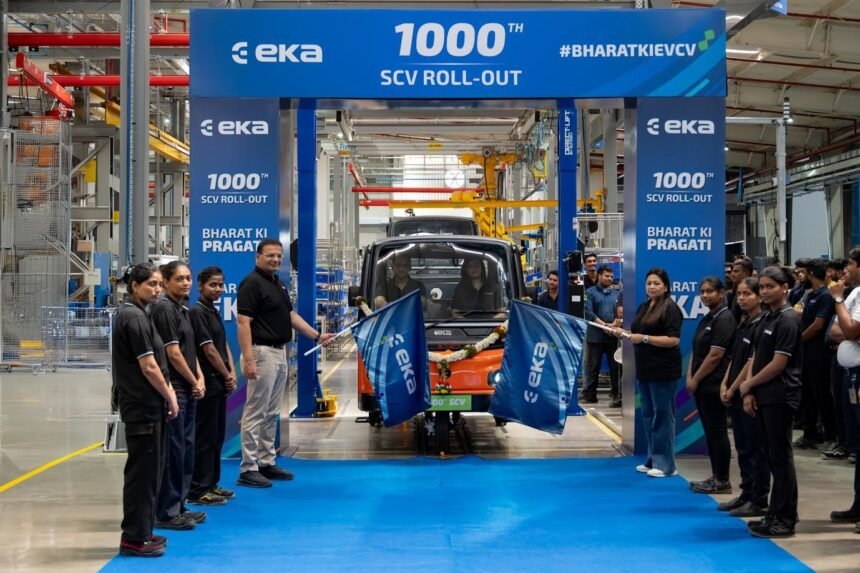
Pune: EKA Mobility, India’s leading electric commercial vehicle manufacturer, announced the rollout of its 1,000th small commercial vehicle (SCV) from its state-of-the-art manufacturing facility in Chakan, Pune. This landmark marks a defining moment in EKA Mobility’s journey and signals a significant leap forward in India’s transition to sustainable and zero-emission urban logistics. The company, a Champion OEM under the Government of India’s Auto PLI Scheme, is backed by VDL Groep (Netherlands), Mitsui & Co. (Japan), NIIF India-Japan Fund, and Enam Holdings.
The 1,000th vehicle – an EKA 6S was formally handed over to the Dagdusheth Halwai Ganpati Trust, one of Pune’s most revered charitable institutions renowned for its extensive humanitarian and civic activities. The EKA 6S is India’s first steering-wheel passenger electric three-wheeler with driver + 6 seating capacity. The Dagdusheth Halwai Ganpati Trust will deploy the EKA 6S as part of its community service operations, making it a fitting symbol of the intersection of faith, service, and sustainable progress.
In a highlight that brought an international dimension to the day’s celebrations, EKA Mobility handed over its EKA 3S electric three-wheeler to H.E. Marisa Gerards, the Hon’ble Ambassador of the Kingdom of the Netherlands to India. This milestone reflects EKA Mobility’s expanding global partnerships and the shared vision of India and the Netherlands to accelerate the transition towards green and sustainable urban mobility. The Netherlands has long been a global leader in sustainable mobility policies and is also home to EKA Mobility’s strategic partner, VDL Groep. This symbolic handover reflects a natural alignment of values and a shared vision for a zero-emission future.
The Chakan plant, which serves as EKA Mobility’s dedicated hub for SCV and Truck manufacturing, has rapidly scaled its operations since inception. With an installed capacity of 24,000 commercial vehicles per year, the facility employs over 1,000 people and houses a state-of-the-art R&D centre with over 400 engineers and designers. Under its EvolutioNARI initiative, EKA Mobility has established an all-women-led assembly line for its SCVs, reflecting the company’s commitment to empowering women and building a more inclusive manufacturing workforce. The milestone comes amid the growing adoption of electric commercial vehicles across passenger mobility, e-commerce, FMCG distribution, and last-mile logistics in India.
Speaking on the occasion, Dr. Sudhir Mehta, Founder & Chairman, EKA Mobility said, “The 1,000th SCV rolling off our Chakan facility is not merely a production number; it is proof of what Indian engineering, innovation, and determination can achieve. It reflects years of perseverance and a shared belief that India can emerge as a global leader in sustainable mobility through world-class products designed and manufactured at home. As we celebrate this achievement on World Environment Day, we are reminded that our purpose extends beyond manufacturing vehicles. We are building solutions that help businesses operate more sustainably, reduce environmental impact, improve everyday mobility, and contribute to a cleaner future for generations to come.”
“All our manufacturing plants are smart, lean, and technology-driven facilities built to scale rapidly. As India’s electric commercial vehicle market accelerates, EKA is perfectly positioned to be the preferred partner for operators seeking reliable, zero-emission vehicles”, added Dr Mehta.
EKA is the only OEM that offers a robust, full-stack ecosystem of commercial electric vehicles from 3-wheelers and SCVs to buses and trucks, all designed, engineered, and manufactured in India, supporting the Government’s Atmanirbhar Bharat vision. The company operates 3 manufacturing facilities – the Bus Plant in Koregaon Bhima and the Trucks & SCV facility in Chakan, Pune. Its upcoming 47-acre Pithampur plant will further expand capacity. Once fully operational, these facilities will support an annual production capacity of 15,000 buses, 24,000 SCVs and 4,000 trucks.