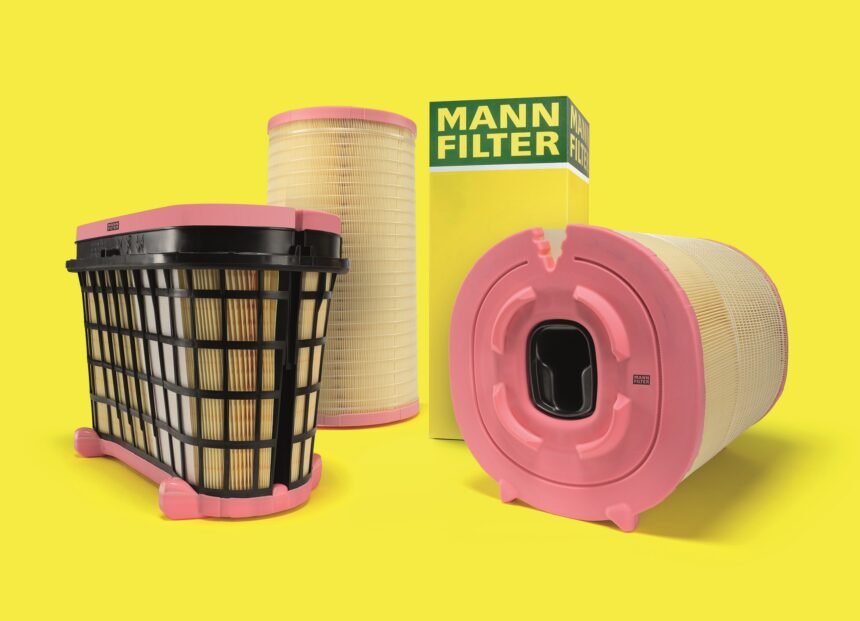
Ludwigsburg: Filtration specialist MANN+HUMMEL has introduced a new generation of MANN-FILTER air filters for commercial vehicles featuring an in-house developed nanofiber layer, aimed at delivering higher filtration efficiency, extended service intervals and improved engine protection, the company said.
The company said the nanofiber coating is designed to reliably capture the finest particles from intake air even in harsh and dusty operating environments such as construction sites and unpaved roads. The advanced filtration technology ensures high separation efficiency while maintaining minimal flow resistance, helping improve engine performance and reduce maintenance requirements.
MANN-FILTER: High-Performance, OE Quality
As a global MANN+HUMMEL premium brand, MANN-FILTER is known in the independent aftermarket for its high-performance filters that meet original equipment quality. Its innovative nanofiber technology is used, for example, in the MANN-FILTER C 50 004/1 air filters for the Mercedes-Benz Actros II, in the C 26 024 kit for the DAF XF 105 and XF 106, and in the C 29 046 for the latest XG-generation DAF trucks. This modern technology provides tangible added value for workshops and wholesalers.
Exclusive Nanofiber Layer
“The ultra-fine nanofiber layer in our filters is the result of the expertise of nearly 1,100 researchers and developers worldwide who are constantly working on innovative technologies. The result is an exclusive filter medium that is available only to MANN+HUMMEL—no other filter manufacturer has access to it. This allows us to provide our customers with filtration performance that stands out on the market thanks to its combination of nanofiber technology, service life and flow rates,” Jörg Schömmel explains as Senior Range Manager IAM at MANN+HUMMEL.
Nanofiber filter media consist of a cellulose base onto which ultra-fine polymer fibers are applied in ultra-thin layers. The fibers are not visible to the naked eye. With an average diameter of just 0.15 to 0.13 micrometers, the nanofibers are up to 500 times finer than a human hair and up to 300 times finer than the fibers of the base material. This significantly increases the surface area available for particle capture, which greatly improves the filter’s dust holding capacity.
While the base material alone traps about 40 percent of particles of this size, the nanofiber filter medium achieves a separation efficiency of up to 99.98 percent. Even the tiniest impurities are filtered out of the intake air almost completely and are deposited on the surface of the medium. This prevents particles from entering the base medium and clogging pores there. This supports long service intervals.
Despite the high separation efficiency, the flow resistance remains low. At the same time, the small fiber diameter ensures a stable fiber network and reduces the risk of tears. In addition, the filter medium meets other requirements of modern commercial vehicle applications: The flame-retardant impregnation enhances safety in the air induction system; furthermore, the medium is characterized by high water stability. Particularly in the commercial vehicle segment, uncompromising quality is essential to avoid costly breakdowns and downtime—and the demands placed on the components and materials used are correspondingly high.